Showing posts with label Toronto. Show all posts

Saturday, March 1, 2014

The lions of March (part 2)

More of Toronto's architectural lions to mark the beginning of March...

Unfortunately, I don't have much any information on the history of the buildings to which these fellows are attached.

I talked to the then-owner of the house that sports these lions, but none of the very detailed information she gave me squared with anything I later looked up. So just enjoy these not-terribly ferocious-looking felines:


This guy has graced this yellow building (which has been a variety of restaurants) for as long as I've been in Toronto, in the Yonge-Eglinton neighbourhood:


Here is a newer cat (judging from the relative newness of the house), in one of Toronto's tonier 'hoods:


And finally, the lion I am most curious about. This fellow and his brothers appear on a number of houses in North Toronto. They're all made of cast stone, so are suffering varying degrees of erosion. But to get an idea of how really small they are, see how they barely register when you view the whole house. Maybe these are cowardly lions?


Tomorrow, some windy architectural sculpture...

The lions of March (part 1)

March has arrived. In Toronto, there are no alerts or warnings or red notifications on the Weather Network. But the forecast is for more wintry weather for the foreseeable future.

So it's as true as ever this year that March comes in like a lion (and — one can only hope this year — will go out like a lamb).

To mark the start of March, I thought I'd post some of Toronto's architectural lions:

If this were a human face tangled up in foliage, it would be called a "green man." I don't know if there is a category of architectural sculpture known as the "green lion," but there ought to be, based on this example alone.

Lions may be so ubiquitous in architectural sculpture because of their frequent use in heraldry, and because they stand for virtually everything.

This building is currently a branch of the Canadian Imperial Bank of Commerce (CIBC), at Church and Carlton, but it was originally the Somerset House Hotel, built in 1895 by Frederick H. Herbert and remodelled in 1930 by Langley & Howland.

In entry for Herbert in the online Biographical Dictionary of Architects in Canada 1800-1950, Robert Hill says he was a proponent of the Queen Anne style and his work was characterized by circular corner towers (of which this is a modified example).

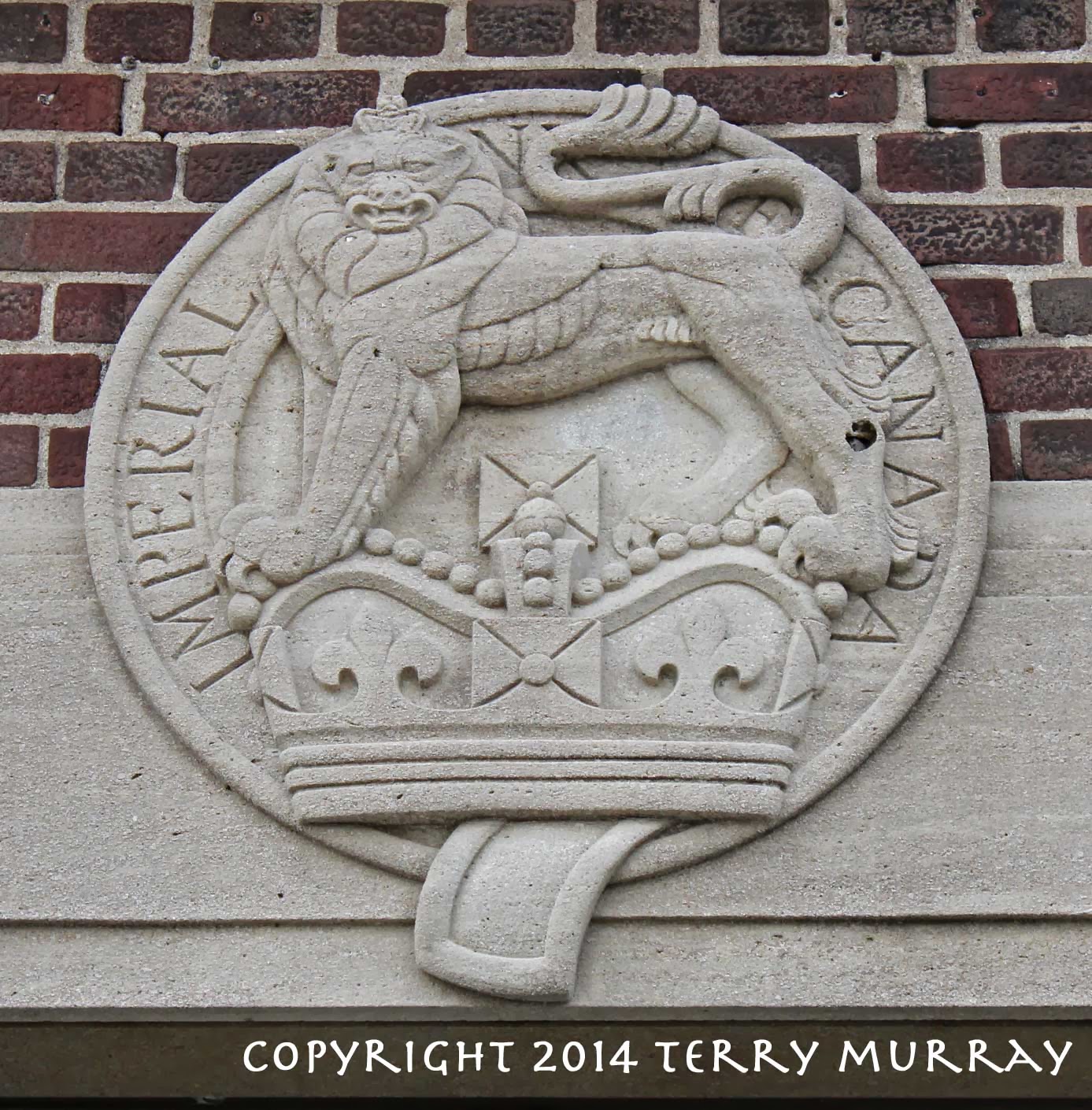
Here's another CIBC lion, although from the days when it was just the Imperial Bank of Canada, and before its merger with the Canadian Bank of Commerce in 1961.


I shot this on a recently closed CIBC branch in Leaside. The building has recently been sold to a developer. It was built in 1940-1941 as the official bank to the former Town of Leaside and, according to the building's heritage property nomination form, was the scene of a Boyd Gang hold up.


Monday, January 27, 2014

What a gas! The clock is back!

Over the Christmas holidays, I was driving past the old Consumers Gas Showroom, on Yonge Street north of Eglinton in Toronto and happened to glance up at the clock. The clock that hasn't worked — at least, not for long — for at least the last 20 years.

Well, what to my wondering eyes should appear, but a cleaned-up, lit-up, working clock!


(Yes, I know — this is a daylight photo of the clock.)

I guessed — correctly — that the work on the clock had been done by Abernethy and Son, the Richmond Hill-based firm of watch and clockmakers and heritage clock restorers.

I called to find out about the Consumers Gas clock, and found out it was Phil Abernethy (the eponymous "Son") who handled the job. He told me that the original Telechron system was worn out and couldn't be restored. So he installed a main synchronous motor, an AC motor that is synchronized with the frequency of the supply current. If the power supply is interrupted, the clock shuts off for 12 hours, at which time (assuming the hydro has been restored) it begins telling the correct time again. It even has an automatic Daylight Saving Time correction.

"The system is virtually hands-off," Phil said.

The clock's case and the bird on whose back it is borne are made of cast aluminum which was sandblasted, changing the colour from near-black (as in the picture below, from 2005) to a dull grey.


Because it's difficult to apply a finish to aluminum, that's just the naked metal exposed to the elements, meaning it will acquire a darker patina in time, he said.

The southern-exposed clock face — milk glass that is 24 in. (or about 61 cm.) in diameter — was cracked, but that could be repaired without Phil having to reproduce it in acrylic.

It's great to have the clock working again, and so beautifully. It actually was important to the North Toronto community in 1931 when architect Charles Dolphin built the Consumers Gas Showroom.

“A feature required on the building was a clock,” according to a report in the building journal Construction in 1931. “As there was none in the immediate district it was felt that this would be a very useful as well as attractive item if it could be embodied in the design.

“In order that the clock might be visible north and south on Yonge Street it was necessary to extend it out from the face of the building.”

Dolphin accomplished that by placing the clock on “an allegorical design of a bird,” frozen as it was poised for flight to the east, thus allowing people on Yonge Street to see the time. The bird motif was repeated in stone at the corners of the building, atop fluted pilasters.


The birds most resemble the phoenix, the legendary bird that is said to have lived 500 years, burned itself on a pyre, and risen from the ashes to live again. Only missing on this building are the flames that usually accompany representations of the phoenix — unless they were assumed, or the choice of bird was emblematic or a visual joke (Consumers Gas — get it?).

In recent years, the Consumers Gas Showroom building also been a women's fitness centre, a Puma athletic shoe store, Bowerings, the Children's Book Store, and a YWCA. Its latest incarnation is as Casalife, a furniture store that opened in early December, and for which the clock was restored. Nice job, Phil!

Sunday, January 26, 2014

They're no angels, either!

I thought angels were supposed to be ethereal and beatific — qualities that can be conveyed even in stone.

But not the angels in the architecture of Toronto's Loretto Abbey Secondary School.

The Collegiate Gothic school that opened in North Toronto in 1928 has a pair of sweet cherubs on either side of the main entrance, one of which is shown below:


But Findlay and Foulis, the two Scottish-born architects who designed the building, somehow couldn't bring the same charm to the two angels flanking the south entrance:


Is it just me (and I don't mean to be mean), or are those two of the ugliest angels you've seen on any building? And especially a Roman Catholic building?

Friday, December 20, 2013

They're no angels...

Italian priest and self-described "angelologist" Father Renzo Lavatori told a conference on angelic art hosted by the Fondazione Archivio Storico and held in the Vatican-owned Palazzo della Cancelleria that angels don't have wings. In fact, he said, according to a story in Britain's The Independent newspaper that angels don't even have a recognizable human form - that they're more like shards of light.

"Angels do not have wings or look like cherubs,"The Independent quoted Father Lavatori. “You do not see angels so much as feel their presence… They are a bit like sunlight that refracts on you through a crystal vase."

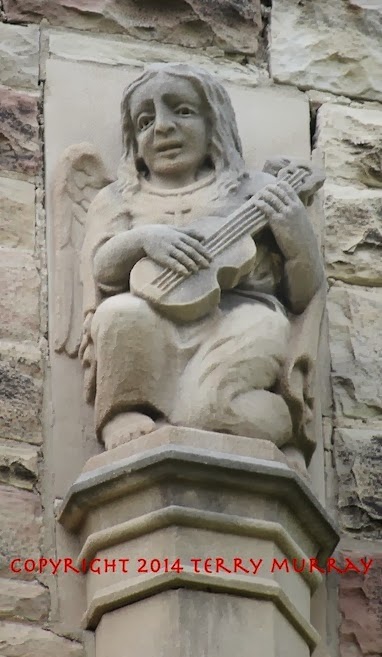
After centuries of seeing angels as winged humans, I'm sticking with that portrayal, as with these angels from the Clarendon Apartments in Toronto (and featured in my book Faces on Places: A Grotesque Tour of Toronto; Anansi, 2006).

I'm not sure that Catholics are angel experts... They're no angels, after all.

Monday, February 20, 2012

More decorated Toronto schools


Harbord Collegiate Institute and Jarvis C.I., both by school-board architect C. E. Cyril Dyson in the 1920s and 1930s, have figures so similar in style that they must have been designed by the same person.

Flanking the main entrance to each building is an academic figure (the Jarvis scholar above - an apparent math phobe, and the Harbord scholar below),


and another pointing to a spherical object that may be a globe — or a ball. (The Jarvis figure is above, and the Harbord fellow is below).


The latter would suggest that the figures illustrate the mens sana in corpore sano philosophy— healthy mind, healthy body. (However, similar figures appear inside Northern Secondary School, where it is more apparent that the spheres are globes and not sport balls.)

Outside the third-storey art-studio window at Jarvis are more student figures, including a reader and a writer.


Central Technical School's scholar and journeyman


Of the four ornamented secondary schools in central Toronto, only Central Technical School has information available about its building’s carved faces — despite publication of individual histories of two of the other schools, and a book devoted to art (including sculpture) in Toronto public schools.

(The original school building was constructed in 1915, designed by architectural firm Ross & Macdonald.)

As described on Central Tech’s web site, at the top of each column supporting the main entrance arch is a “gnome”—a scholar in cap and gown, busily scribbling in a book, and a journeyman with hammer and chisel, representing the two sides of the school’s curriculum. (The tradesman’s hammer has broken and disappeared over the years.)

Sunday, January 22, 2012

The "Handball Gods" of Northern Secondary School, Toronto


I recently discovered the website of The Decorated School Research network, a largely European group whose focus is sculptures and murals in and on 20th Century schools, and the relationships between architects, artists and educators through that art.

"We are interested in understanding more about how the art came to be commissioned, how the subject matter was decided, what was its function, its life story and what ideas about education or childhood, if any, were intended to be conveyed," according to the website.

The network, which seems to have begun last year, has a two-year plan including seminars, a final international conference and a book, motivated by the fear that "many of these [artworks] may be in danger as school buildings are becoming replaced often with scant regard to the treasures that they contain."

Having found this group (which I've included in my list of links, to the right), I thought I'd revisit some of the schools I included in Faces on Places: A Grotesque Tour of Toronto (my 2006 book on Toronto's architectural sculpture) as well as to bring out pictures of school sculptures in Toronto and elsewhere that I haven't included here before.


Northern Secondary School, whose architect was C.E.C. Dyson, the Toronto District School Board's own architect, was built in record time in 1930. When I went to shoot the dozen masks all around building in the summer of 2005, a janitor leaned out a window and called to me, “You taking pictures of the funny people?”


“Funny people” they are indeed—and some are contented, goofy, frightened, frightening, or sad — but there is no information on the Oxford-like faces to be found in architectural journals, at the school itself, or in the Toronto District School Board Archives. (In fact, the archive does not even have a file on Dyson, who was the board’s architect from 1921 to 1949.)

I appealed for information — even pet names that students, faculty, or staff may have had for their stone classmates — on the website for Northern’s 75th anniversary in that year. I heard from several of the original graduates, who had a wealth of information on the history of the school, but nothing specifically about the faces.

Then I heard from Amir Fatemi, a more recent graduate. “When I attended Northern between 1993 and ’98, my friends and I played a lot of handball outside the south doors,” he said. “We frequently referred to the gargoyles as the ‘Handball Gods’ since they could oversee everything.”

There is also a wealth of sculpture inside the school (which is known for its art programmes, among other things), and I was recently told by the parent of a Northern alum that the students paint murals on the lockers in the corridors.

Saturday, December 31, 2011

Neighbourhood lights


As our snow lay on the ground indecisively while the heavens alternately rained and snowed (and sometimes sleeted, or freezing-rained), this snowman kept hanging around (suspended from a tree) in front of a North Toronto house.

Happy new year!

Saturday, January 1, 2011

Sitting on top of the world!


Okay, more like standing. And as for it being the top of the world, it's only the top of Toronto's Old City Hall. This picture was taken in 2003 when the Ventin Group, the restoration architects working on the building, allowed me to come up on the scaffolding of the 103.6-metre tower to take pictures of the gargoyles that were being replaced.

Saturday, November 27, 2010

Why are there two chimps on a girls' school?


The main façade of Bishop Strachan School, the private girls' school in Toronto's tony Forest Hill neighbourhood, sports two stone chimps, each clutching although not apparently restrained by a ball and chain.

Why?

I've searched the internet, called the school, checked a few architectural journal articles from 1916 when Sproatt and Rolph designed the building, and not found the answer.

Does anyone out there know, with a reference? Or have any ideas?

Stay tuned - I haven't given up finding the answer.

Monday, October 18, 2010

Let's put on a show!


My friends Michal and Yaniv at the Yonge/Eglinton Aroma Espresso Bar have booked me for a three-week photo exhibition. The pictures, which I hung on Saturday night, are virtually all from Faces on Places, my book on Toronto's gargoyles and other architectural sculpture.


It seemed like a good theme for the period leading up to and including Halloween. Stop by if you get a chance, between now and the 6th of November.

Sunday, October 10, 2010

Lunch?

You all know the photo - "Lunch Atop a Skyscraper," the one by Charles Ebbets of 11 construction workers sitting on a girder, high above Manhattan, having lunch.

Well, New York sculptor Sergio Furnari has rendered them in 3D, and they caught the eye of Les Abro, president and CEO of billboard company Abcon Media. And now a version on Furnari's sculpture is in my neighbourhood.


At first, I thought this was sort of cool. But as I thought and read about the installation, I realized it wasn't done so much in the name of art as for advertising.

As you can see, the lunching construction workers are no longer seated, but standing - standing so they'll be visible behind billboards.

There is some advertising that functions as art, but not in this case. It turns out that Les Abro has been trying to get these sculptures on top of an uptown Toronto building since 2007. His initial target was Yonge and Eglinton, where they would have supported three billboards:


The Yonge and Eglinton area has plenty of tall buildings so this would have fit in - or at least, fit in better than it does in the Yonge and Lawrence area where it is now. But the city councillor for Yonge/Eg nixed the plan.

Abro managed to get a variance in the zoning bylaw from our councillor, and in June, the sculptures went up in the relatively low-rise neighbourhood, at the corner of Yonge and Deloraine:


In fact, Spacing Toronto published an interesting article detailing the whole story.

I want to like these sculptures. I really do.


But they really don't fit in the Yonge/Lawrence neighbourhood, and the 17 figures are mostly hidden by the billboards. I disagree with Edward Brown, writing on the Torontoist website, that the Furnari sculptures represent "art tinged by artful marketing."

It's art obscured by advertising - and advertising that debases public spaces.

Saturday, September 4, 2010

Time and place


Having spent 10 days in Chicago and with two weeks more off from the day job, I decided to play tourist in Toronto. So I took a double-decker bus tour.

I am as interested in music as the next person — possibly more so, since I used to be a semi-professional musician in another life — but I've never felt the need to be, literally, constantly plugged into the soundtrack of my life. (Neither have I felt the need to be constantly on the phone, but that's a post for another day.)

Anyway, as I was saying before I interrupted myself, I believe in having a life to which the music that I hear forms the soundtrack instead of all-soundtrack-all-the-time.

When I took the coach tour, this girl who sat ahead of me clearly favoured the latter. She generously plugged one ear bud into her own ear, and the second into her mother's ear — rendering them unable to hear the surprisingly informed and witty commentary of the tour guide.

That was their loss, and didn't interfere with my enjoyment of the trip... although I did wonder what the point was of paying nearly $40 and then shutting out the tour guide. (I recognize that language may have been a factor in this case.)

But then the child apparently tired of her iPod — and began serenading us a series of random notes on a blue plastic harmonica, and my mood returned to that one of my stone friends in Chicago:

Saturday, August 22, 2009

Maclean-Hunter Ltd. (RIP)


These aren't from a newspaper office, but from the building that used to be the head office of Maclean-Hunter Ltd. on University Avenue here in Toronto. It was built in 1961 for MH which published Maclean’s and Chatelaine magazines as well as a large stable of trade publications.

Maclean-Hunter had been on this site long before that — the company, including its printing plant, had been on the corner of University and Dundas since 1911. The printing plant moved — when? — to Yonge Street and Highway 401, and later to Aurora, Ont.; Maclean-Hunter moved to College Park (the former Eaton's College Street store) in 1983, and ceased to exist when it was bought by Rogers Communications Inc. in 1995. Rogers now publishes Maclean's, Chatelaine and a much smaller (and shrinking) stable of trade and professional publications (including the Medical Post, where I do my Day Job).

So this building was never actually a newspaper office, but it was the hub of a considerable proportion of Canadian periodical publishing. As I describe in Faces on Places, it features an incised naked woman floating in front of a long ribbon on one side of a building, and a naked man floating and holding a ribbon on the other.

When she won the commission for “exterior decorations” on the new MH building, Elizabeth Wyn Wood apparently thought the company had something more sculptural in mind.

“Symptomatic of the diminishing role and significance of sculptural decoration in modern Canadian architecture, Maclean officials agreed to only two simplified entrance panels on ‘Communications,’” said Victoria Baker in her examination of Wood’s life and work.

“Wood interpreted this theme in the form of female and male nude figures symbolizing ‘Sending’ [above] and ‘Receiving,’ [below] respectively.”

Sunday, July 26, 2009

They're everywhere! Part 2


A few weeks ago, I posted a picture of a gargoyle at Denver International Airport, remarking on how gargoyles (generically speaking) seem to appear everywhere.

Guess where else they appear? How about on a mausoleum? This guy (above) is on the Massey mausoleum in Mount Pleasant Cemetery.

Yes, that's the "Massey" of Massey Hall, Massey-Ferguson, Raymond Massey (the late actor) and Vincent Massey (the first Canadian-born governor general of Canada).

It's not as though the Masseys couldn't have afforded a proper gargoyle. I mean, look at this spout (below) with all the fancy detail around it. With the face on the turret, why couldn't they have sprung for a face on the spout that would turn it into an honest-to-god gargoyle?

Saturday, July 18, 2009

Sculpture: from clay model to bronze statue

Earlier this week, I was one of 20 people on a tour sponsored by the Art Gallery of Ontario of the Artcast foundry in Georgetown, where Eric Knoespel (left) and his staff have been casting sculptures in clay and other impermanent materials into bronze and other metals for years.

We were walked through all stages of the process, from producing a rubber mold of the original (on the table in the picture at left), to making a wax duplicate which is then covered with a ceramic shell mold (which Eric is displaying, above and below).


(See the red wax inside the ceramic shell? Click on picture to see larger.)


The wax is then melted out of of the ceramic shell. The shell is fired for extra strength and then placed in a bucket of sand, at which time the molten metal is poured in the ceramic mold:


Link


The mold and metal are left to cool, at which point the ceramic mold is chipped away, and voila! A bronze sculpture!
Okay, this is a very oversimplified explanation of how it's done — there are several additional steps throughout the process I've described, and afterward. For example, the Glenn Gould statue in front of the CBC Broadcasting Centre on Front Street was cast by Artcast, and a work that size has to be done in pieces, which means there are later steps in its reconstruction.
But essentially, that's how it's done. And Eric gave a great tour.