Monday, January 27, 2014

What a gas! The clock is back!

Over the Christmas holidays, I was driving past the old Consumers Gas Showroom, on Yonge Street north of Eglinton in Toronto and happened to glance up at the clock. The clock that hasn't worked — at least, not for long — for at least the last 20 years.

Well, what to my wondering eyes should appear, but a cleaned-up, lit-up, working clock!


(Yes, I know — this is a daylight photo of the clock.)

I guessed — correctly — that the work on the clock had been done by Abernethy and Son, the Richmond Hill-based firm of watch and clockmakers and heritage clock restorers.

I called to find out about the Consumers Gas clock, and found out it was Phil Abernethy (the eponymous "Son") who handled the job. He told me that the original Telechron system was worn out and couldn't be restored. So he installed a main synchronous motor, an AC motor that is synchronized with the frequency of the supply current. If the power supply is interrupted, the clock shuts off for 12 hours, at which time (assuming the hydro has been restored) it begins telling the correct time again. It even has an automatic Daylight Saving Time correction.

"The system is virtually hands-off," Phil said.

The clock's case and the bird on whose back it is borne are made of cast aluminum which was sandblasted, changing the colour from near-black (as in the picture below, from 2005) to a dull grey.


Because it's difficult to apply a finish to aluminum, that's just the naked metal exposed to the elements, meaning it will acquire a darker patina in time, he said.

The southern-exposed clock face — milk glass that is 24 in. (or about 61 cm.) in diameter — was cracked, but that could be repaired without Phil having to reproduce it in acrylic.

It's great to have the clock working again, and so beautifully. It actually was important to the North Toronto community in 1931 when architect Charles Dolphin built the Consumers Gas Showroom.

“A feature required on the building was a clock,” according to a report in the building journal Construction in 1931. “As there was none in the immediate district it was felt that this would be a very useful as well as attractive item if it could be embodied in the design.

“In order that the clock might be visible north and south on Yonge Street it was necessary to extend it out from the face of the building.”

Dolphin accomplished that by placing the clock on “an allegorical design of a bird,” frozen as it was poised for flight to the east, thus allowing people on Yonge Street to see the time. The bird motif was repeated in stone at the corners of the building, atop fluted pilasters.


The birds most resemble the phoenix, the legendary bird that is said to have lived 500 years, burned itself on a pyre, and risen from the ashes to live again. Only missing on this building are the flames that usually accompany representations of the phoenix — unless they were assumed, or the choice of bird was emblematic or a visual joke (Consumers Gas — get it?).

In recent years, the Consumers Gas Showroom building also been a women's fitness centre, a Puma athletic shoe store, Bowerings, the Children's Book Store, and a YWCA. Its latest incarnation is as Casalife, a furniture store that opened in early December, and for which the clock was restored. Nice job, Phil!

Sunday, January 26, 2014

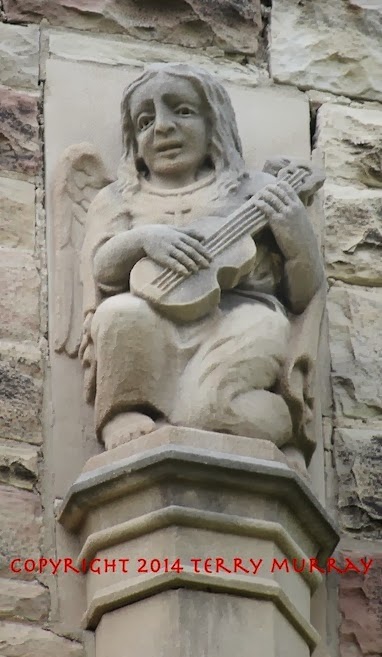
They're no angels, either!

I thought angels were supposed to be ethereal and beatific — qualities that can be conveyed even in stone.

But not the angels in the architecture of Toronto's Loretto Abbey Secondary School.

The Collegiate Gothic school that opened in North Toronto in 1928 has a pair of sweet cherubs on either side of the main entrance, one of which is shown below:


But Findlay and Foulis, the two Scottish-born architects who designed the building, somehow couldn't bring the same charm to the two angels flanking the south entrance:


Is it just me (and I don't mean to be mean), or are those two of the ugliest angels you've seen on any building? And especially a Roman Catholic building?

Friday, December 20, 2013

They're no angels...

Italian priest and self-described "angelologist" Father Renzo Lavatori told a conference on angelic art hosted by the Fondazione Archivio Storico and held in the Vatican-owned Palazzo della Cancelleria that angels don't have wings. In fact, he said, according to a story in Britain's The Independent newspaper that angels don't even have a recognizable human form - that they're more like shards of light.

"Angels do not have wings or look like cherubs,"The Independent quoted Father Lavatori. “You do not see angels so much as feel their presence… They are a bit like sunlight that refracts on you through a crystal vase."

After centuries of seeing angels as winged humans, I'm sticking with that portrayal, as with these angels from the Clarendon Apartments in Toronto (and featured in my book Faces on Places: A Grotesque Tour of Toronto; Anansi, 2006).

I'm not sure that Catholics are angel experts... They're no angels, after all.

Monday, May 28, 2012

Many thanks to Doors Open Toronto and...

all the enthusiastic gargoyle hunters who came out for the Faces on Places walking tours! You have motivated me to update and maintain this blog after a lapse (due to the crush of work at my day job). Stay tuned - new posts coming soon! Keep looking up! For those of you who couldn't make it: CTV News walked with us on the first tour on Saturday (http://toronto.ctv.ca/ - look under "Latest Videos" tab on the right for "Doors Open city architecture tours kick off"), and CBC Radio's Here and Now promo'd the walks on Friday but they don't seem to have archived the interview (or not yet).

Monday, February 20, 2012

More decorated Toronto schools


Harbord Collegiate Institute and Jarvis C.I., both by school-board architect C. E. Cyril Dyson in the 1920s and 1930s, have figures so similar in style that they must have been designed by the same person.

Flanking the main entrance to each building is an academic figure (the Jarvis scholar above - an apparent math phobe, and the Harbord scholar below),


and another pointing to a spherical object that may be a globe — or a ball. (The Jarvis figure is above, and the Harbord fellow is below).


The latter would suggest that the figures illustrate the mens sana in corpore sano philosophy— healthy mind, healthy body. (However, similar figures appear inside Northern Secondary School, where it is more apparent that the spheres are globes and not sport balls.)

Outside the third-storey art-studio window at Jarvis are more student figures, including a reader and a writer.


Central Technical School's scholar and journeyman


Of the four ornamented secondary schools in central Toronto, only Central Technical School has information available about its building’s carved faces — despite publication of individual histories of two of the other schools, and a book devoted to art (including sculpture) in Toronto public schools.

(The original school building was constructed in 1915, designed by architectural firm Ross & Macdonald.)

As described on Central Tech’s web site, at the top of each column supporting the main entrance arch is a “gnome”—a scholar in cap and gown, busily scribbling in a book, and a journeyman with hammer and chisel, representing the two sides of the school’s curriculum. (The tradesman’s hammer has broken and disappeared over the years.)